Book of Dede Korkut
A work consisting of tales that narrate the epic life of the Oghuz.
- Period
- 15th c. (written down, estimated)
- Format
- Facsimile
- Details
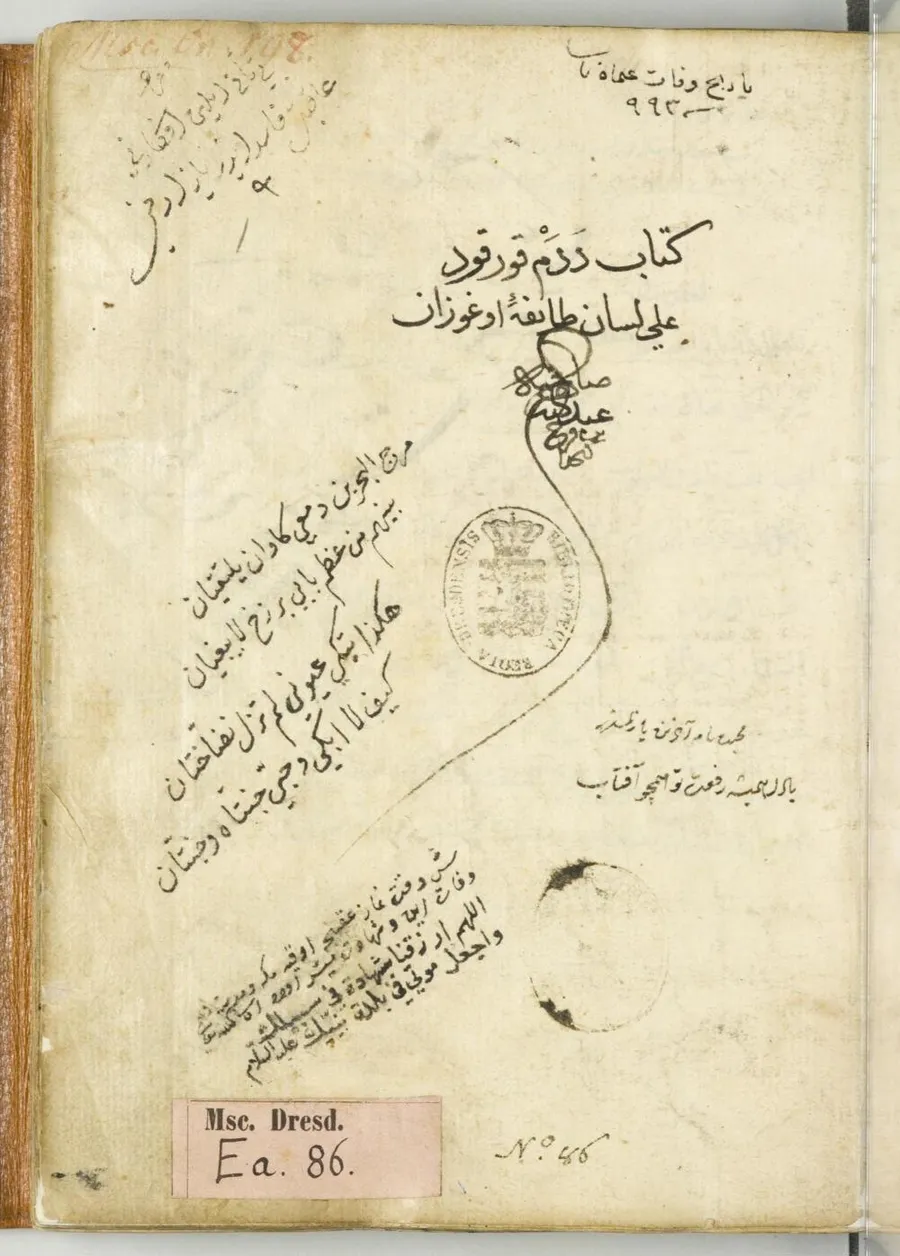
- Dresden manuscript, SLUB Mscr.Dresd.Ea.86 · 16th c. · 152 folios · 12 tales
- Region
- Azerbaijan, Kazakhstan, Türkiye, Turkmen Sahra (Iran)
About the work
The Book of Dede Korkut consists of tales that narrate the epic life of the Oghuz. According to the TDV Encyclopaedia of Islam, these tales form a work in which Turkic morals and customs, beliefs and heroic deeds are told authentically. The tales contain verse passages called “soylama”, which do not follow the regular measures of syllabic metre and resemble a kind of free verse. Throughout the work Dede Korkut is depicted as the forefather of the people, a learned man, a folk bard and a sage; it is he who gives counsel and shows the way. The epic culture, folk tales and music of Dede Korkut were inscribed in 2018 on UNESCO’s Representative List of the Intangible Cultural Heritage of Humanity as an element shared by Azerbaijan, Kazakhstan and Türkiye.
According to the TDV Encyclopaedia of Islam, the tales are estimated to have been written down in the second half of the 15th century, and the region ruled by the Ak Koyunlu is generally accepted as the place where they were written. Most of the historical and geographical names in the tales show that they date from before the Oghuz left Turkestan. The language of the work shows the features of the Azeri dialect; however, when compared with present-day Azeri, not all of its linguistic features are found to belong to that dialect.
The Dresden manuscript has been known since 1815 and the Vatican manuscript since 1950. The Dresden manuscript is now kept at the Saxon State and University Library (SLUB) under the shelfmark Mscr.Dresd.Ea.86; the library’s record dates it to the 16th century, describes it as 152 folios and lists twelve chapters (tales). The second manuscript, in the Vatican Library (no. 102), was introduced by the Italian Turkologist Ettore Rossi. The 1994 article of the TDV Encyclopaedia of Islam speaks of two manuscripts of the work; according to an article published in 2023 in Türk Dili, the journal of the Turkish Language Association, however, the number of known Dede Korkut manuscripts has reached five with the emergence of the Ankara manuscript in 2017, the Günbed manuscript in 2019 and the Bursa manuscript in 2022. The Günbed manuscript, also called the Turkmen Sahra manuscript, was bought in Tehran on 12 December 2018 by the collector Veli Muhammed Hoca, who lives in Gonbad-e Kavus in the Turkmen Sahra region of Iran. According to the same article, the Bursa manuscript is kept in the Muradiye Museum of the Qur’an and Manuscripts and contains the twelve tales of the Dresden manuscript in the same order.
The work was first published by Kilisli Muallim Rifat (Bilge) in Istanbul in 1332 under the title Kitâb-ı Dede Korkud alâ Lisân-ı Tâife-i Oğuzân; the TDV states that this edition has some gaps and errors because it is based only on the Berlin manuscript. The Berlin manuscript is a copy of the Dresden manuscript made by Diez. Orhan Şaik Gökyay published the work in 1938 under the title Dede Korkut, and in 1973, taking the Dresden manuscript as the basis and adding the additional passages of the Vatican manuscript, under the title Dedem Korkudun Kitabı. Muharrem Ergin published the work in two volumes in Ankara in 1958 and 1963, including facsimiles of the Dresden and Vatican manuscripts.