Kutadgu Bilig
The work in the masnavi form written by Yusuf Khass Hajib in the 11th century; according to the TDV Encyclopaedia of Islam, one of the most important sources for the Turkic language, literature and cultural history.
- Author
- Yûsuf Has Hâcib
- Period
- 1069–1070
- Format
- Transcription
- Details
- Yusuf Khass Hajib · 6,645 couplets · Vienna, Cairo and Fergana manuscripts
- State
- Karakhanids
About the work
Kutadgu Bilig, whose title means “the knowledge that brings happiness”, is a work written to show the path to be followed to attain happiness in both worlds. The Turkish Language Association presents the work as an example of a mirror for princes in verse; the TDV Encyclopaedia of Islam, by contrast, regards it not as a dry book of advice but as a system of life philosophy that defines the duties of the individual within society and the state. The work is built on four principles: just law is represented by the khagan Kün-Toğdı, happiness by the vizier Ay-Toldı, intellect by the vizier’s son Ögdülmiş, and the end of life by the ascetic Odgurmış. The qualities and duties of the persons who hold offices such as khagan, vizier, commander, chamberlain and envoy are described in separate chapters.
What is known about the author consists of two prefaces added to the work later, one in prose and one in verse, and of information in some of the work’s couplets. According to the TDV Encyclopaedia of Islam, Yusuf Khass Hajib was born into a noble family in Balasagun, wrote his work in a year and a half in Balasagun, completed it in Kashgar in East Turkestan, and presented it in 1069–1070 to the Karakhanid khagan Tavgach Ulugh Bughra Khan. The khagan gave the poet the office of khass hajib. The Turkish Language Association states that the work consists of 6,645 couplets.
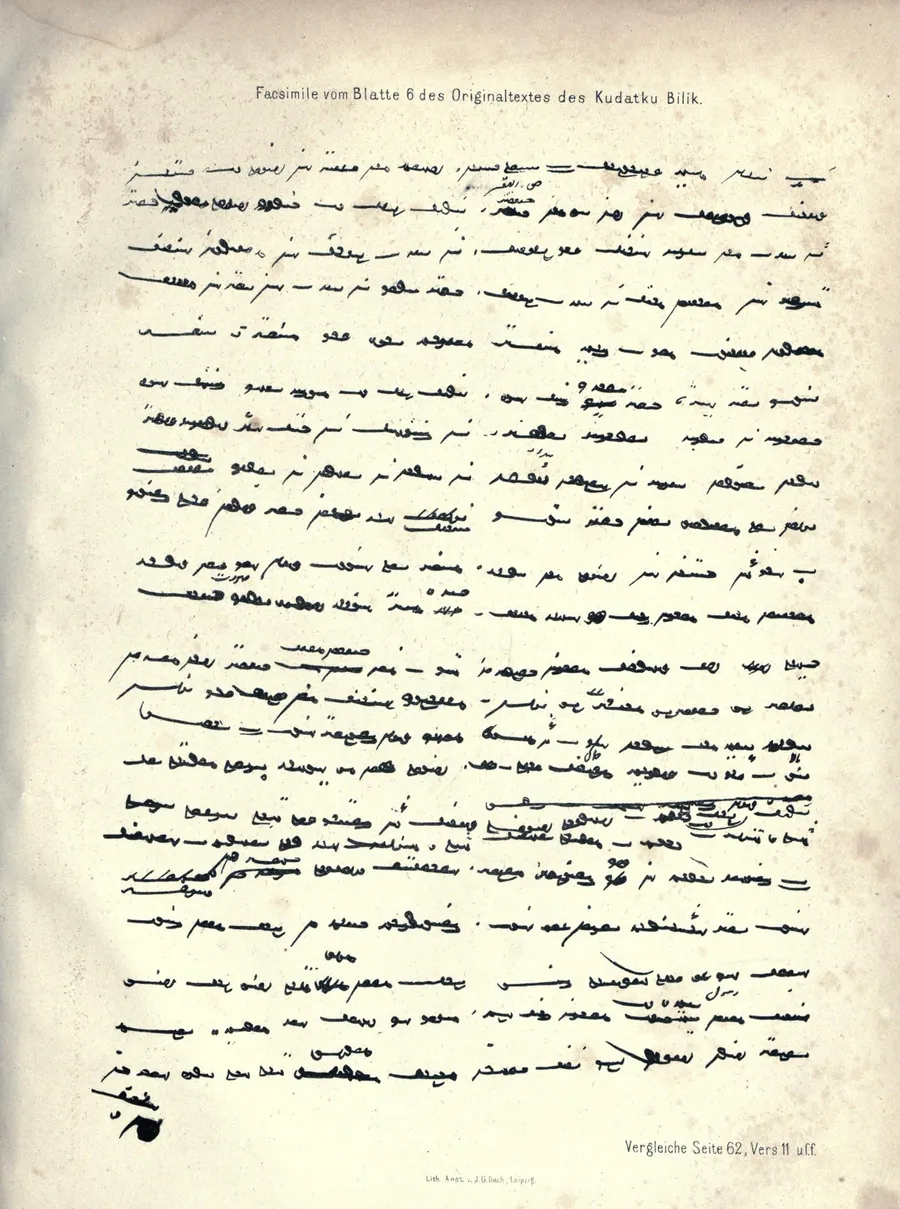
According to the 2002 article of the TDV Encyclopaedia of Islam, of the known manuscripts of the work one is written in Uyghur and two in Arabic script, and all three belong to the third redaction of the work. The Herat manuscript, known as the Vienna manuscript, was copied in Uyghur script from a copy written in Arabic script. The Cairo manuscript, in Arabic script, was prepared for Izz al-Din Aydemir al-Dawadar, a mamluk of the Mamluk sultan al-Malik al-Nasir. The TDV states that the best of the extant manuscripts is the Fergana manuscript in Arabic script.
The work was introduced to scholarship by Pierre-Amédée Jaubert in 1825, and in 1870 Hermann Vámbéry discussed its origin, history and language. In 1890 Wilhelm Radloff published a facsimile of the first known manuscript of the work and, comparing it also with the Cairo manuscript, published the first part of the text in 1900 and the second in 1910. Facsimiles of the three manuscripts were published by the Turkish Language Association in 1942–1943, and the critical text prepared by Reşit Rahmeti Arat was printed in 1947 and his translation in 1959. According to the Turkish Language Association, a facsimile of the Vienna, Cairo and Fergana manuscripts was produced in three volumes in 2015, and its second edition appeared in 2018.